 Brandshoes.eu







 Polski
 English
 English (Canada)
 English (Australia)
 Български
 Română
 Magyar
 Čeština
 Slovenčina
 Nederlands
 Nederlands (België)
 Français
 Українська
 Ελληνικά
 Lietuvių kalba
 Italiano
 Español
 Português
 Latviešu valoda
 Eesti
 Türkçe
 العربية
 简体中文
 Русский
 Slovenščina
How to Waterproof Shoes for Fall and Winter (and Remove Road Salt)


How do you waterproof shoes so the spray really protects them? Start with clean, dry shoes, keep them away from the radiator, and treat full-grain leather differently from suede. Here are five steps, a materials table, a way to deal with white road salt stains, and a rule for when to reapply.
The most common waterproofing mistake goes like this: shoes come home soaked from the rain, get a dose of spray, and end up next to the radiator. The waterproofing spray then settles on the water and mud instead of in the leather, and the hot air does the rest. Collonil, a maker of shoe care products, warns that shoes dried on a radiator can become brittle. So before you look up how to waterproof shoes made of a particular material, remember the order: clean, dry, and only then spray.
Good waterproofing takes a quarter of an hour of work and one night of waiting. Full-grain leather needs a different approach than suede and nubuck, and shoes with a membrane need yet another. Below is the sequence that works on men’s leather shoes and women’s alike, followed by the differences between materials and a way to deal with white road salt stains.
Waterproofing Shoes Step by Step
- Clean. Take out the laces, brush off dry dirt with a soft brush, and wipe stains with a cloth dampened with lukewarm water. Spray applied over dust and mud only locks them in.
- Dry. At room temperature, away from the radiator, hair dryer, and sun. Put paper inside and replace it when it gets damp. For suede, use plain, unprinted paper—Timberland warns that newspaper ink can transfer.
- Do a patch test. Spray a little on the tongue or near the heel and wait a few minutes. If the color hasn’t changed, you can go ahead.
- Spray evenly, without soaking. From the distance given on the can (for Collonil Carbon Pro it is about 30 cm), cover the whole upper, the seams, and the join between the upper and the sole. Two thin coats are better than one that leaves streaks.
- Give it time. Collonil specifies at least 20 minutes of drying time at room temperature, and the second coat goes on once the first is dry. It is easiest to waterproof your shoes in the evening and put them on in the morning.
Full-Grain Leather, Suede, Nubuck, or Textile: What to Use
The same spray won’t suit every pair. The simplest approach is to check the material on the product page and choose a product to match the upper, not the shoe brand.
| Material | What to use | What to watch out for |
|---|---|---|
| Full-grain leather (smooth) | leather cream or wax, then spray; finish by buffing | a radiator and a hair dryer dry out the leather |
| Suede and velour leather | suede spray, then a brush to raise the nap | creams and wax clump the nap and leave dark stains |
| Nubuck | spray for suede and nubuck, a suede eraser for light dirt | same as with suede: nothing greasy |
| Textile and mesh | all-purpose spray on clean, washed material | don’t dry it on a radiator or with a hair dryer |
| Membrane upper (GTX, WP) | a spray compatible with the upper material; for textiles, a water-based one | no bleach or stain removers when washing |
Suede and nubuck have a rough, open surface that water easily soaks into along with salt, which is why you waterproof them before the first wear, not after the first stain. Keep a brush handy: after every spray, the nap needs to be raised; otherwise, the shoe looks worn.
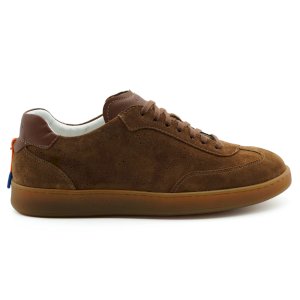 Domeno C0112BR1352_BR
View product
 Domeno 7549RN1202_ZIEL
View product
 Reebok CL LTHR Crepe Neutr
View product
Winter Shoes and Shoes with a Membrane
A membrane, such as GORE-TEX or CMP ClimaProtect, is a layer under the outer material of the upper that keeps water from getting inside. The outer material still gets saturated if there is no water-repellent coating, and sweat doesn’t evaporate as well through a wet upper. This is how Adidas explains it in its guide to GORE-TEX shoes, adding that the factory coating wears off with use, so it needs to be renewed.
At the time of writing, almost half of the models in men’s winter shoes have leather uppers, and among men’s hiking and trapper boots you will find models with a membrane, such as the CMP Rigel Mid with a ClimaProtect membrane. With knee-high boots, you waterproof the whole shaft, from the ankle to the top edge.


How to Remove Salt from Leather and Suede Shoes
The white marks are road salt that soaked in with the water and crystallized as the shoes dried. The simplest approach is to remove it the same evening, while the stains are still fresh.
- Dry first: brush off the loose salt crystals before you wet anything.
- Solution: Timberland recommends 1 part vinegar to 2 parts water, applied with a soft cloth—the same method for leather, suede, and nubuck. Wipe off the residue with a clean, damp cloth.
- Drying: overnight, in a well-ventilated spot, with paper inside and away from the radiator.
- Finish: for full-grain leather, apply cream or waterproof it; for suede and nubuck, waterproof and brush them—this is how the Gusti Leder leather lexicon finishes the job.
Faux leather doesn’t need vinegar: just wipe it with a cloth dampened with lukewarm water. If you are buying shoes for the season and can’t decide, our guides to men’s fall shoes and fall women’s shoe trends 2026 compare materials with rain in mind.
How Often to Waterproof Shoes
- Suede and nubuck
- Before the first wear, after every cleaning, and whenever the one-drop test shows that water is soaking in.
- Full-grain leather
- Cream or wax when the leather loses its shine or after salt removal; spray when water stops beading on it.
- Sports shoes
- Collonil recommends renewing the protection every 12–15 workouts.
- Shoes with a membrane
- When water soaks into the upper instead of running off, even if the inside stays dry.
The rule for the whole season is simple: if water soaks in instead of running off, waterproof right away, and if the shoes have been cleaned or washed, always waterproof them. Looking for a pair that will handle winter more easily? Women’s leather shoes and women’s winter boots made of full-grain leather need the least effort.
Frequently asked questions
Related posts

How to Choose Your Jeans Size: W and L Step by Step + Mustang Chart
How do you choose your jeans size so the 32/32 on the label fits you? We explain W and L, show how to measure in four steps, share Mustang’s official men’s and…
Read more
Fall Women’s Shoe Trends 2026 and How to Wear Them
Fall women’s shoe trends 2026 are slim retro sneakers, soft loafers, and ankle boots on a stable block heel, ideally in brown, olive, or burgundy. We show what…
Read more
Shoe Size Chart: EU, UK, US and cm, and Differences Between Brands
A shoe size chart gives centimeters, but not always the same kind: sometimes it is foot length, sometimes the Japanese size from the size label, and at Domeno i…
Read more
Comments (0)
No comments yet. Be the first to comment!